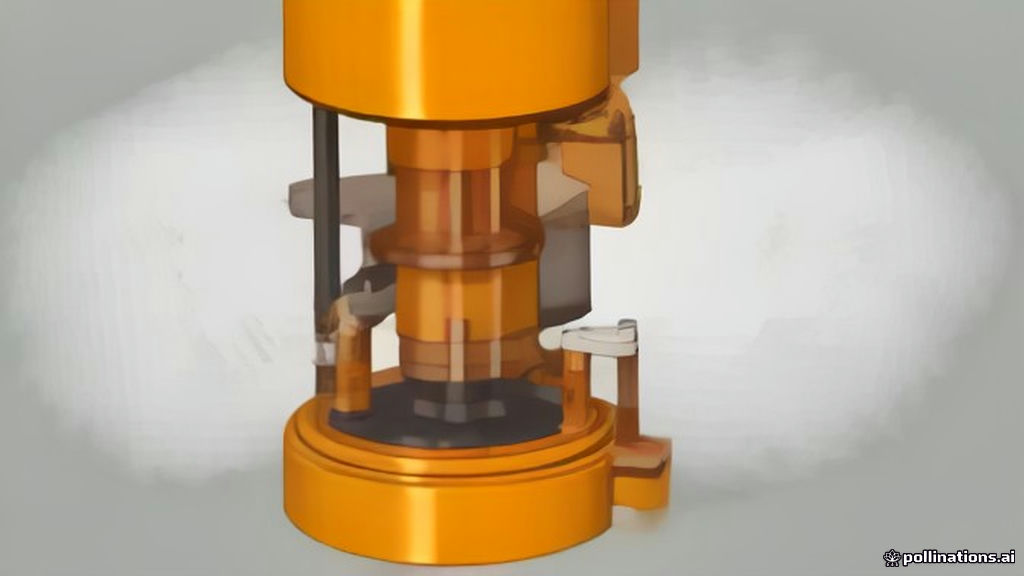
Ever wondered why a tiny syringe can lift a heavy load?
That trick comes from a neat rule about how pressure works in liquids. Let’s see why it matters for your everyday gadgets and your exam.
💡 In Simple Words: When you push on a liquid in a closed container, that push (pressure) spreads equally in every direction. So a small force applied over a tiny area can create a big force over a larger area.
What is pressure in fluids?
Pressure is just the force you apply divided by the area it acts on. Think of it like the weight you feel when you stand on a floor: the heavier you are, the more pressure on the floor tiles. In fluids (liquids or gases) we use the same idea, but the fluid can push back in all directions.
Pascal’s law explained
Pascal’s law says: any change in pressure applied to an enclosed fluid is transmitted undiminished throughout the fluid. In plain talk, if you press on one part of a sealed liquid, that pressure jump shows up everywhere else, just the same.
Imagine a garden hose. When you squeeze the hose with your hand, the water pressure builds up and you feel the spray get stronger at the nozzle. The water inside the hose is the “enclosed fluid” and your hand’s squeeze is the extra pressure. The increase doesn’t disappear; it travels all the way to the tip.
Why does the pressure stay the same?
Fluids can’t resist shape changes, so they just push equally in all directions. It’s like a crowd of people in a room; if one person pushes the wall, everyone else feels the same shove because there’s nowhere else to go.
Worked example: the hydraulic press
Suppose you have a simple hydraulic press with two pistons connected by a tube filled with oil. The small piston has an area of 0.005 m² and you push down with a force of 50 N. The large piston has an area of 0.2 m². How much lift can the large piston provide?
- First, find the pressure you create on the small piston: P = F/A = 50 N / 0.005 m² = 10,000 Pa (Pascal is the unit of pressure).
- Pascal’s law tells us the same 10,000 Pa appears on the large piston.
- Now calculate the lift force on the large piston: F = P × A = 10,000 Pa × 0.2 m² = 2,000 N.
So a modest 50 N push on the small piston can lift a whopping 2,000 N (about 200 kg) on the big piston. That’s the magic of pressure transmission.
When does Pascal’s law NOT work?
The law assumes the fluid is incompressible (doesn’t change volume) and the container is sealed. Air, being compressible, only follows the rule approximately. Leaky containers also break the condition.
Quick comparison: Pascal’s law vs. simple force multiplication
| Aspect | Pascal’s law | Simple lever |
|---|---|---|
| How force is transferred | Through pressure in a fluid, equal in all directions | Through a rigid bar pivoting around a fulcrum |
| Key requirement | Closed, incompressible fluid | Rigid, non‑deforming bar |
| Typical use | Hydraulic brakes, car lifts | Seesaws, crowbars |
Key points to remember
- Pressure (P) = Force (F) ÷ Area (A).
- Pascal’s law: pressure change in a sealed fluid spreads equally in every direction.
- Because pressure is uniform, a small force on a small area can generate a large force on a bigger area.
- Hydraulic systems (brakes, lifts) rely on this principle.
- Assumptions: fluid is incompressible and container is airtight.
📝 Likely Exam Questions
- State Pascal’s law in your own words.
Answer: Any increase in pressure applied to a confined fluid is transmitted equally throughout the fluid, so every part of the fluid experiences the same pressure change. - A hydraulic jack has a small piston of area 0.01 m² and a large piston of area 0.4 m². If a force of 80 N is applied on the small piston, what is the lifting force on the large piston?
Answer: Pressure on small piston = 80 N / 0.01 m² = 8,000 Pa. Lifting force = 8,000 Pa × 0.4 m² = 3,200 N. - Why does a car’s brake system use fluid instead of a solid rod?
Answer: Fluid can transmit pressure instantly through a closed system, allowing a small foot force on the brake pedal to produce a large braking force at each wheel without the need for a massive solid rod. - Give one real‑life example where Pascal’s law is applied and explain how it works.
Answer: A dental syringe uses Pascal’s law. Pressing the plunger increases pressure in the fluid inside; that pressure travels to the tiny tip, pushing the fluid out to clean a tooth. - What would happen to the pressure transmission if the hydraulic fluid were air instead of oil?
Answer: Air is compressible, so the pressure would not transmit uniformly; some of the applied force would compress the air, reducing the effective force on the output piston.