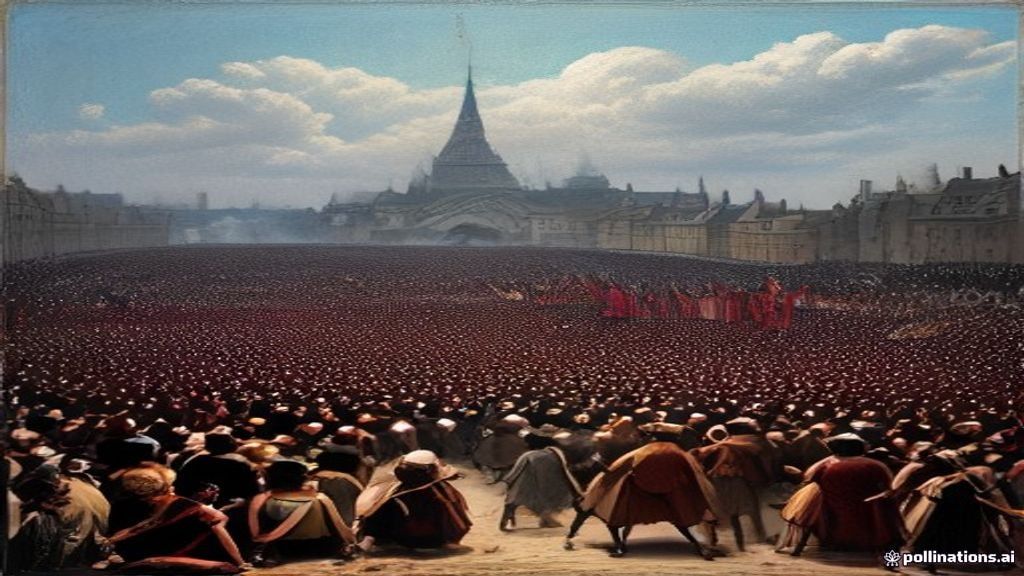
Why did a loaf of bread become a revolution?
Picture a Parisian bakery in 1789 where the price of a simple loaf jumps so high that families start arguing in the streets. That anger didn’t stay in the kitchen—it boiled over into a national upheaval that still shapes our world today.
💡 In Simple Words: The French Revolution happened because ordinary people were fed up with an unfair king, heavy taxes, and hungry bellies. It turned the whole country upside‑down, giving ideas like liberty and equality a real chance.
What sparked the French Revolution?
Historians point to three big buckets of causes: political, social, and economic. Think of them like three leaky pipes that all burst at once.
Political causes
The king, Louis XVI, ruled like a referee who never listened to the players. He could change laws without asking anyone, and he kept power in a tiny circle of nobles. The Estates-General—a meeting of the three estates (the clergy, the nobles, and the commoners) that hadn’t been called since 1614—was finally summoned because the king needed money. Imagine a school where the principal decides everything, but suddenly the students and teachers are invited to a meeting they’ve never had before. That meeting quickly turned into a demand for a new rulebook.
Social causes
French society was split into three estates. The First Estate (clergy) and Second Estate (nobles) enjoyed privileges like tax breaks, while the Third Estate—about 98% of the population—shouldered most taxes and had almost no say. It’s like a family where two kids get dessert for free and the third kid has to finish all the veggies before getting any sweets.
Economic causes
France’s treasury was empty after costly wars (think of the American Revolution as a big credit‑card bill). Bad harvests made bread prices soar, and the government kept raising taxes on the poor. When the price of a loaf doubles, families start to panic—just like a household that suddenly faces a huge utility bill.
Key phases of the Revolution (quick flowchart)
Major impacts of the French Revolution
The Revolution didn’t just rewrite French history; it sent shockwaves across the globe. Below are the most lasting effects.
- End of the Ancien Régime: The old system of monarchy and feudal privileges was ripped apart. Think of it as tearing down a crumbling house to build a new one with open doors.
- Spread of ideas: Words like liberty, equality, fraternity became rallying cries worldwide, inspiring movements in Latin America, Europe, and later the United States.
- Rise of modern politics: The concept of a citizen’s rights and a written constitution entered everyday talk. It’s similar to moving from “my dad decides everything” to “we all vote on the rules”.
- Legal reforms: The Napoleonic Code, drafted after the Revolution, standardized laws and influenced many countries’ legal systems.
- Secularism: The church’s power over education and public life was reduced, paving the way for a more secular (non‑religious) state.
Comparison: Before vs. After the Revolution
| Aspect | Before 1789 (Ancien Régime) | After 1799 (Napoleonic France) |
|---|---|---|
| Political power | Absolute monarch (king) with divine right | Consul/Emperor with a constitution (though still strong) |
| Social hierarchy | Three estates, privileges for clergy & nobles | Legal equality for all male citizens |
| Legal system | Patchwork of local customs | Uniform Napoleonic Code |
| Religion | Church owned lands, huge influence | State secular, church property confiscated |
How to remember the causes quickly
Use the mnemonic PEE—Political, Economic, Equality. Political = weak king, Economic = starving bread, Equality = unfair estates.
📝 Likely Exam Questions
- Explain two political causes of the French Revolution. Model answer: The king’s absolute rule without a parliament and the long‑uncalled Estates‑General forced the king to seek money, exposing his inability to govern with consent.
- How did the French Revolution affect societies outside France? Model answer: It spread ideas of liberty and equality, inspiring revolts in Haiti, Latin America, and later influencing the 1848 European revolutions.
- What was the significance of the National Assembly? Model answer: It marked the shift from the old estates to a body representing the nation, leading to the Declaration of the Rights of Man and the abolition of feudal privileges.
- List two lasting legal impacts of the Revolution. Model answer: The Napoleonic Code created a uniform legal system, and the principle of secular law reduced church interference.
- Why is the phrase ‘Liberté, égalité, fraternité’ still important today? Model answer: It encapsulates the core values that emerged from the Revolution and continue to shape democratic constitutions worldwide.