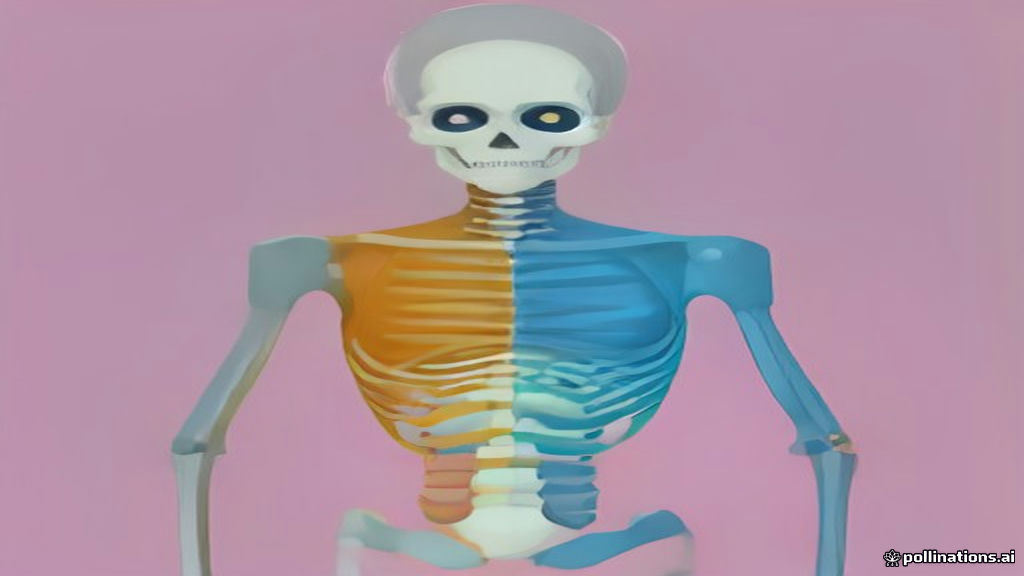
Why the skeleton is more than just a frame
Ever wondered why you can stand, run, or even smile? Your skeleton is the backstage crew making the show possible.
💡 In Simple Words: The human skeletal system is the collection of all the bones, cartilage, and joints that give our body shape, protect vital organs, and let us move. Think of it as the sturdy scaffolding of a house, but it also helps you dance.
What is the human skeletal system?
The skeletal system is simply the whole set of bones in your body, plus the cartilage (the smooth, rubbery stuff at the ends of bones) and the joints where bones meet. In total, an adult has 206 bones, each with a special job.
Major functions of our bones
- Support: Bones act like the pillars of a building, holding up your body.
- Protection: The skull guards your brain, the rib cage shields the heart and lungs.
- Movement: Muscles pull on bones; joints act like hinges, letting you swing your arms or kick a ball.
- Mineral storage: Bones store calcium and phosphorus, releasing them when the body needs them.
- Blood cell production: Inside many bones is a spongy tissue called marrow that makes red blood cells, white blood cells, and platelets.
Two big divisions: axial and appendicular skeleton
The skeleton splits into two main groups. The axial skeleton is the central core – it includes the skull, vertebral column (spine), and thoracic cage (rib cage). The appendicular skeleton covers everything that hangs off the core – the shoulder girdle, arms, pelvic girdle, and legs.
Key bones you must remember
Here are the headline bones that often pop up in ICSE questions:
- Skull – protects the brain.
- Mandible – the only movable bone of the skull, forms the lower jaw.
- Clavicle (collarbone) and scapula (shoulder blade) – form the pectoral girdle.
- Humerus – upper arm bone.
- Radius and ulna – forearm bones.
- Femur – longest bone, thigh.
- Tibia and fibula – lower leg bones.
- Patella – kneecap, a small shield for the knee joint.
- Pelvic bones – ilium, ischium, pubis, together they support the trunk.
- Ribs – protect heart and lungs; twelve pairs in total.
- Vertebrae – 33 small bones forming the spine, divided into cervical, thoracic, lumbar, sacral, and coccygeal regions.
Types of bones and their shapes
Not all bones look the same. Scientists group them by shape:
- Long bones: longer than they are wide (e.g., femur, humerus). Good for leverage.
- Short bones: roughly cube‑shaped (e.g., carpals in the wrist). Provide stability and some movement.
- Flat bones: thin and broad (e.g., sternum, scapula). Protect organs.
- Irregular bones: complex shapes (e.g., vertebrae, facial bones). Fit together in special ways.
- Sesamoid bones: tiny round bones embedded in tendons (e.g., patella). Reduce friction.
Joint types you’ll see in the exam
Joints are where two bones meet. They fall into three categories:
- Fibrous joints: bones glued together, little to no movement (e.g., sutures of the skull).
- Cartilaginous joints: cartilage cushions the bones, allowing slight movement (e.g., intervertebral discs).
- Synovial joints: most movable joints, filled with synovial fluid that lubricates the joint. Examples include the elbow, knee, and shoulder.
How bones grow and stay strong
Bone isn’t a dead rock; it’s living tissue that constantly remodels. Two main cell types do the work:
- Osteoblasts: “bone builders” that lay down new bone matrix.
- Osteoclasts: “bone recyclers” that break down old bone.
When you exercise, osteoblasts get a boost, making bones denser. When you’re sedentary, osteoclasts may outpace them, leading to weaker bones.
Quick revision summary
- The skeletal system = bones + cartilage + joints.
- 206 bones in an adult.
- Axial skeleton = skull, spine, rib cage.
- Appendicular skeleton = girdles + limbs.
- Functions: support, protection, movement, mineral storage, blood cell production.
- Bone types: long, short, flat, irregular, sesamoid.
- Joint categories: fibrous, cartilaginous, synovial.
- Bone remodeling involves osteoblasts (building) and osteoclasts (recycling).
📝 Likely Exam Questions
- Name the two major divisions of the human skeleton and give two examples from each.
Answer: Axial skeleton – skull, vertebral column. Appendicular skeleton – humerus, femur. - State three functions of the skeletal system.
Answer: Provides support, protects vital organs, assists movement (also stores minerals and produces blood cells). - Differentiate between a long bone and a flat bone with examples.
Answer: Long bone is longer than wide, e.g., femur; flat bone is thin and broad, e.g., sternum. - What type of joint is the knee and why is it classified that way?
Answer: The knee is a synovial joint because it has a fluid‑filled cavity that allows a wide range of movement. - Explain how regular exercise influences bone health.
Answer: Exercise stimulates osteoblast activity, increasing bone formation and density, making bones stronger.