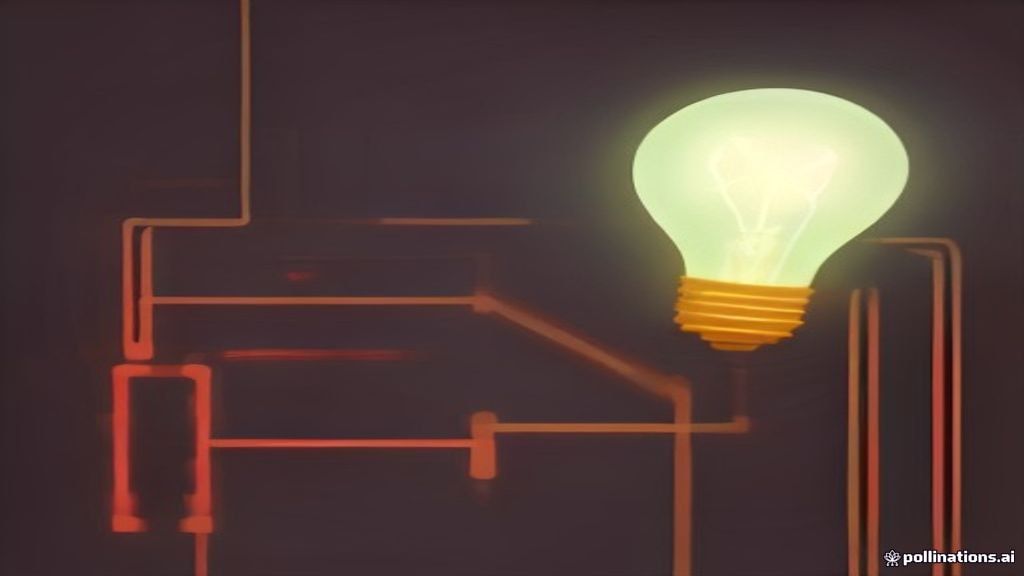
Why Ohm’s Law matters in everyday life
Ever wondered why a flashlight gets dimmer when its batteries run low? That’s Ohm’s Law in action, and it’s the same rule that powers everything from smartphones to kitchen mixers.
💡 In Simple Words: Ohm’s Law tells us how voltage (the push), current (the flow), and resistance (the roadblock) are linked. Change one, and the others adjust automatically.
What is Ohm’s Law?
Ohm’s Law is a simple equation that says V = I × R. Here’s what each symbol means:
- V (voltage) – the electrical “pressure” that pushes electrons, like water pressure in a hose.
- I (current) – the rate at which electrons move, similar to the amount of water flowing per second.
- R (resistance) – anything that opposes the flow, just as a narrow pipe slows water.
When you know any two of these, you can find the third. That’s the magic trick every ICSE exam loves.
Key terms explained
Voltage (V) is measured in volts. Think of it as the “push” that makes electrons move.
Current (I) is measured in amperes (A). It tells you how many electrons pass a point each second.
Resistance (R) is measured in ohms (Ω). It’s the material’s tendency to slow down the electron flow.
How to use Ohm’s Law in simple circuits
Most class‑10 questions give you a tiny circuit with a battery, a resistor, maybe a lamp. Follow these four steps and you’ll never get stuck.
Step‑by‑step solving method
- Read the question carefully. Write down what you know: V, I or R.
- Identify the total resistance if there are more than one resistor. For series, add them; for parallel, use 1/R_total = 1/R1 + 1/R2 …
- Pick the right form of Ohm’s Law. If you need current, use I = V / R. If you need voltage, use V = I × R, etc.
- Do the arithmetic, keep units straight, and double‑check the answer makes sense (e.g., current can’t be negative).
Worked example 1: Finding current
A 9 V battery is connected to a resistor of 3 Ω. What is the current flowing?
Step 1: V = 9 V, R = 3 Ω, we need I.
Step 2: Use I = V / R.
Step 3: I = 9 V ÷ 3 Ω = 3 A.
So the circuit carries 3 amperes of current.
Worked example 2: Finding resistance
A lamp glows with a current of 0.5 A when connected to a 12 V supply. What is the lamp’s resistance?
Step 1: I = 0.5 A, V = 12 V, we need R.
Step 2: Rearrange Ohm’s Law to R = V / I.
Step 3: R = 12 V ÷ 0.5 A = 24 Ω.
The lamp’s resistance is 24 ohms.
Quick reference table
| What you know | What you need | Formula to use |
|---|---|---|
| V and R | I | I = V ÷ R |
| V and I | R | R = V ÷ I |
| I and R | V | V = I × R |
📝 Likely Exam Questions
- Question: A 6 V cell is connected to two resistors in series, 2 Ω and 4 Ω. Find the current.
- Answer: Total R = 2 Ω + 4 Ω = 6 Ω. I = V / R = 6 V ÷ 6 Ω = 1 A.
- Question: In a parallel circuit, two branches have resistances 3 Ω and 6 Ω. The applied voltage is 12 V. Calculate the total current supplied.
- Answer: 1/R_total = 1/3 + 1/6 = 1/2 ⇒ R_total = 2 Ω. I_total = 12 V ÷ 2 Ω = 6 A.
- Question: A bulb draws 0.2 A from a 9 V battery. What is its resistance?
- Answer: R = V / I = 9 V ÷ 0.2 A = 45 Ω.
- Question: Explain why the current decreases when a resistor of higher value is added in series.
- Answer: Adding resistance raises the total R, and Ohm’s Law (I = V / R) tells us that for a fixed voltage, a larger R gives a smaller I. It’s like narrowing a water pipe – less water (current) can flow.