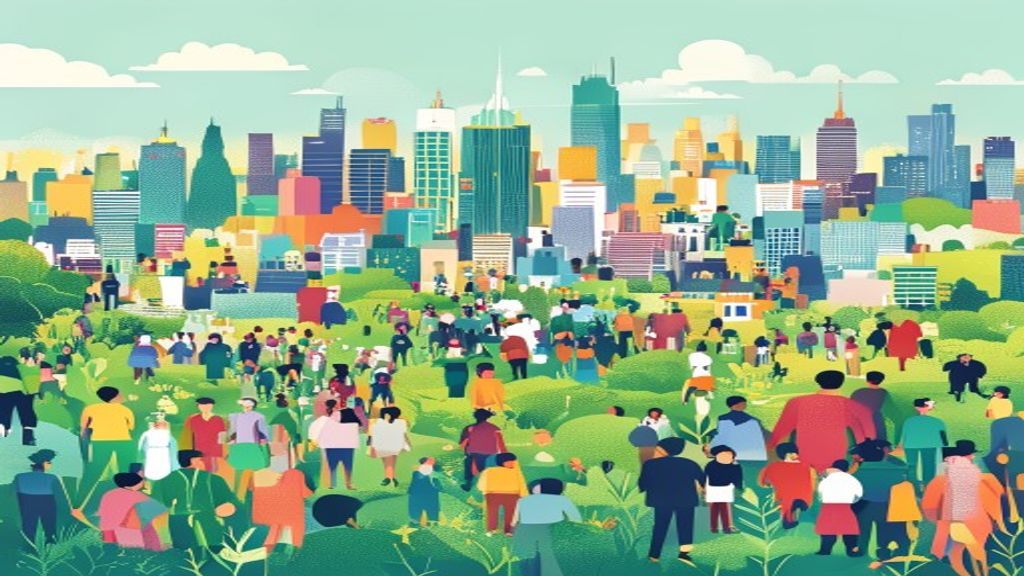
Why does human population matter?
Ever wondered why news headlines scream about "overpopulation"? It's not just hype – the number of people on Earth shapes everything from the food on our plates to the air we breathe.
💡 In Simple Words: Human population growth means more people are being added to the world each year. This rise changes how we use land, water, and other resources, and it can create challenges for societies.
What is population growth?
Population growth is the increase in the number of individuals in a given area over time. Think of it like a bathtub filling up: the water level (people) rises when the tap (births) runs faster than the drain (deaths).
Key terms
- Population: All the people living in a particular place.
- Growth rate: The speed at which a population gets bigger, usually expressed as a percentage per year.
- Birth rate: Number of babies born per 1,000 people each year.
- Death rate: Number of deaths per 1,000 people each year.
- Migration: Movement of people into (immigration) or out of (emigration) a region.
- Carrying capacity: The maximum number of people an environment can support without breaking down. Imagine a bus that can only seat 50 passengers – once it's full, no more can board without causing chaos.
Causes of rapid population increase
Several factors push the numbers up:
- High birth rate: In many rural areas, larger families are seen as economic security.
- Lower death rate: Better medical care, vaccines, and sanitation let more people live longer.
- Immigration: People move to cities or other countries seeking jobs and safety.
- Improved women’s health: Longer reproductive years add to the pool of potential mothers.
How does growth translate into impact?
More people mean more demand. The chain reaction looks something like this:
Major impacts
- Resource depletion: Forests are cut, groundwater is over‑used, and fish stocks shrink.
- Environmental degradation: More waste, higher carbon emissions, and loss of biodiversity.
- Housing shortage: Slums grow as cities can’t keep up with the influx.
- Health challenges: Overcrowded clinics, spread of diseases, and nutrition gaps.
- Social pressure: Competition for jobs, education, and basic services intensifies.
Comparison table: Impact vs. Example
| Impact | Real‑world example |
|---|---|
| Water scarcity | Groundwater levels dropping in Punjab, India |
| Air pollution | Smog episodes in Delhi during winter |
| Deforestation | Forest loss in the Amazon for agriculture |
What can be done?
Governments and communities use several tools to balance growth:
- Family planning: Providing contraception and education lowers birth rates.
- Education, especially for girls: Informed choices delay marriage and child‑bearing.
- Sustainable agriculture: Techniques that yield more food with less land.
- Urban planning: Building affordable housing and efficient public transport.
Why does this matter for ICSE exams?
The board loves real‑life connections. You’ll be asked to link causes with effects, draw simple diagrams, and suggest solutions. Knowing the vocabulary and having a clear cause‑effect chain will fetch you marks.
📝 Likely Exam Questions
- Define population growth and mention two factors that increase it.
Answer: Population growth is the rise in the number of individuals in a region over time. It rises when birth rate is high and death rate is low, or when immigration adds people. - Explain how a high birth rate can lead to environmental stress.
Answer: A high birth rate boosts the population, which raises demand for food, water, and land. To meet this demand, forests are cleared and water sources are over‑exploited, causing habitat loss and pollution. - List three impacts of overpopulation on human health.
Answer: (i) Overcrowded hospitals, (ii) Faster spread of infectious diseases, (iii) Poor nutrition due to food scarcity. - Suggest two measures a government can take to control rapid population growth.
Answer: Implement family‑planning programmes and promote education for girls. - Draw a short flowchart showing the link between population increase and housing problems.
Answer: Students should sketch a simple diagram: Population increase → Urban migration → Overcrowding → Housing shortage → Slum formation.